
Financial Literacy 101 – Power of Compounding

Warren Buffett credits it as the most powerful factor in his investing successes.

Albert Einstein calls this the 8th wonder of the world. He who understands it, earns it.. he who doesn’t… pays it.

Compound interest!

In this article, we highlight (with relevant examples) the mighty power of compounding.

Case study 1

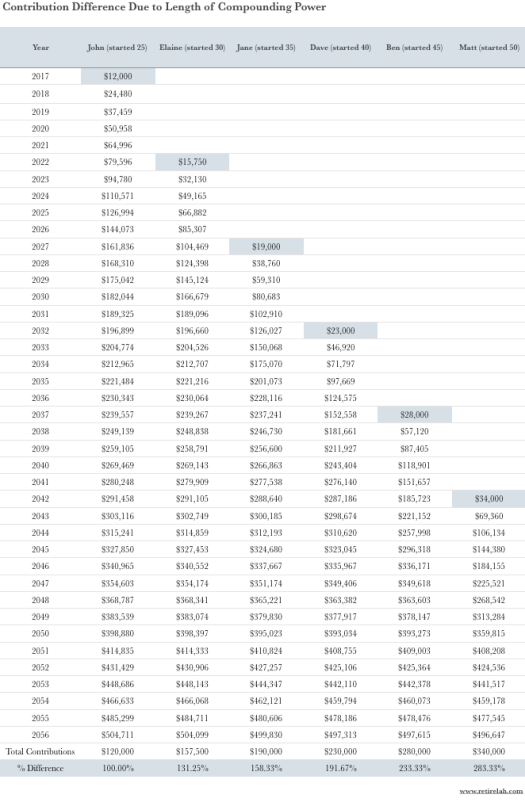
John started saving $12,000 annually ($1,000 per month) from 25 years old to 65 (40 years). Assuming his portfolio generates a 4% return, his $480,000 contribution will be at a handsome $1.14million at the end of 40 years. Have a look at the different amounts by saving $1,000 monthly at different ages.

RL - Conpound Interest A.png

The differences in interest earned due to compounding power is evident! Here’s another case study to illustrate the power of compounding. Here we look at the difference in monthly contributions because we allow more(less) time for compound interest to work for us!
 

RL -Compound Interest B.png

Due to the length of time to let compounding work its magic, John only contributed $12,000 yearly compared to Matt’s $34,000 (~2.83 times) to achieve similar results. That’s a big big difference!


As the investor John C Boyle puts it, “Time is your friend; impulse your enemy.” Finding a portfolio that generates 4% returns is not going to be risk free, it is important that we do lots of homework and then make our money work for us. If not, it maybe better to consider either putting it in the bank or putting it in CPF?

Compound interest – Make him your friend (today).

Look out for our next contributions as we will be discussing more about these topics!

Retirement Facts – Rising Cost of Living (Part 2/5)

Another fact that directly impacts our retirement planning will be the rising cost of living. Inflation.

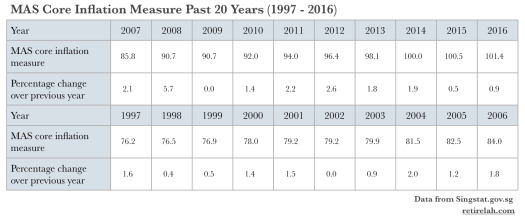
Here we look at the data from singstat.gov.sg

RL - MAS Core Inflation Measure

We look at the MAS core inflation measure* which gives important indicator of price developments in Singapore. It is less volatile than the CPI inflation but co-integrated with it.

*Note that the MAS core inflation measure excludes cost of accommodation and private road transport given the high home-ownership rate as well as the long intervals between new car purchase for most owners.

From the table above, we see that inflation in Singapore ranges from 0 – 5.7 percent with 17 out of the 20 years lower than 2.5% and 15 of the 20 years lower than 2%.

We are using 2.5% inflation from this exercise and have created tables to illustrate the difference between taking inflation into consideration and not. The results are significant.

The most recent household expenditure survey (2012/13) by Singstat.gov.sg showed Singapore household spending SGD4,724 monthly.

RL - Inflation adjusted household expenditure example

18 years of net $4724 monthly spending = $1,587,264

18 years of inflation adjusted monthly spending = $2,259,595

That’s a BIG difference of $672,331! 

Hence, it is important to note that prices are going to continue going up (especially with all the QE done around the world post 2008 crisis).

Adjusting for inflation is necessary for any retirement planning.


You can read Part 1 of series here; Life Expectancy.

Stay tuned for our next part!


Retirement Facts – Life Expectancy (Part 1/5)

Fact 1 – Longer Life Expectancy 

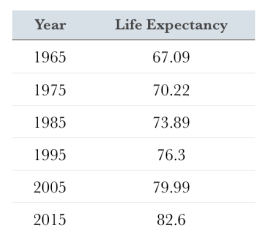
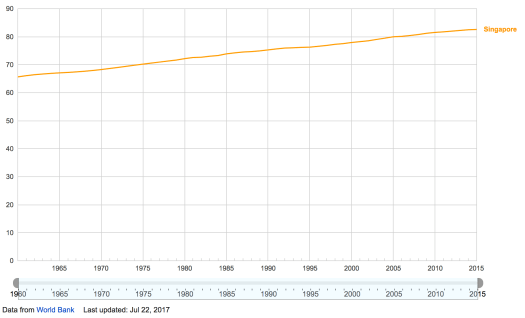
Average life expectancy have increased with advancement of healthcare and awareness.

Singaporeans are living longer and we have to take this into consideration when planning for our retirement.

RL - SG Life Expectancy 2

RL - SG Life Expectancy

Looking at the above data, we are very roughly estimating the following life expectancies for the different age groups.

Disclaimer: Please note that these are average life expectancies and the actual lifespan of an individual can be longer/shorter. Our rough extrapolations below are merely guesstimates.

RL - SG Life Expectancy 3

Our purpose here is to illustrate that we will be living longer and we will require more savings for our retirement. For people in their 40s, 30s and 20s, we should plan retirement around an increased life expectancy figure and not kid ourselves that we will live “shorter”. This is important as the difference can be very significant.

Imagine Alex, a 37 year old, planning retirement based on 2015 life expectancy figures of 83 years vs the extrapolated guesstimates of 95 years.

That is a 12-years difference and very possibly a different “retirement”

A prudent retirement plan will NEED to consider the above.

Click here for the next part of the series, Retirement Facts – Cost of Living (Part 2/5).


Retirement Basics – Overview

In this mini-series, we will be discussing about the common topics surrounding retirement (in a slightly more concise manner). The main purpose is to provide

  1. Overview of what retirement is and why is it important
  2. Discuss the possible ways to planning retirement
  3. How to reach retirement targets
  4. Being happy and fulfilled with life post-retirement


Before we go on, please pause for a minute – and take time to think* about what does retirement mean to you and why is it important?

.

.

.

.

.

*Good and thank you for participating. Active reading and critical thinking helps you in your process of retirement planning.

Live, Love, Laugh.

Getting the retirement you want (for most people the list below generally looks similar):

  • Being healthy
  • Being happy
  • Living fulfilling days
  • Being financially independent
  • Have little or no worries on all or most of above


Some readers (by now) may want to jump straight into how to retire (now). Disclaimer: RL is not a get-rich-quick website so no, we won’t be able to give you a stock tip or disclosing a magical route to early retirement.

Retirement planning takes time, commitment and a lot of effort.

Alright, if you’re ready, let’s start!